What are you looking for?


Overview:
The aluminum profile is an aluminum material obtained by hot melt and extrusion to obtain different cross-sectional shapes. The production process of aluminum profiles mainly includes three processes of casting, extrusion and coloring.
Product Origin:
ChinaShipping Port:
ShanghaiLead Time:
25


Introduction detail:
The aluminum profile titanium plating process belongs to the coating technology. It is a step of adding pre-plating and electroplating processes on the basis of the conventional titanium plating process. The aluminum profile process is to chemically treat the activated plated parts in an aqueous solution of salt and hydrochloric acid.
The bath composition of the electroplating process includes nickel sulfate, nickel chloride, boric acid, sodium lauryl sulfate, saccharin, and brightener. The process has the advantages of simplicity, practicability, good effect, etc. The titanium-aluminum profile obtained by the process has a film hardness of HV ≈ 1500, and is 150 times more wear-resistant than the 22K gold plated under the same conditions, and can be processed into various forms of gold, A variety of aluminum profiles in bright colors such as color and black.
1. Resistance to corrosion;
2. Thermal conductivity rate;
3.Non-ferromagnetic;
4. Machinability ;
5. Formability;
6. Recyclability ;
7. Electrical conductivity
System Overview An Aluminum Honeycomb Cleanroom Panel bonds two thin metal facings to a lightweight aluminum honeycomb core — an ultra-flat, high-rigidity, A-grade cleanroom wall and ceiling panel made to a ≤ 2 mm/2 m flatness tolerance. Key advantages: Lightweight & Strong: High strength-to-weight ratio — ideal for FFU and walkable ceilings. Ultra-Flat & Rigid: Dimensionally stable, sag-free surface for high-grade flush finishes. A-Grade & Clean: Non-combustible, corrosion-resistant, anti-static and dust-free.

Overview: Clean room single glass window the glass used is tempered glass/reinforced glass. Tempered glass is actually a type of prestressed glass. In order to increase the strength of the glass, chemical or physical methods are usually used to form compressive stress on the surface of the glass. When the glass is subjected to external force, the surface stress is first offset, thereby improving the bearing capacity and enhancing the resistance of the glass itself. Wind pressure, cold and heat, impact and so on.

System Overview A cleanroom injection panel is a foam-injected PU/PIR sandwich panel engineered for ultra-low thermal conductivity and fully airtight sealing in cleanroom, cold-storage and HVAC construction. Foamed continuously between two coated galvanized steel facings, this panel forms a seamless, gap-free enclosure that eliminates dust traps and air leakage points. Available in framed PUR construction (aluminum or iron frame) or frameless, fully automated PIR construction, it is the preferred choice for facilities requiring superior insulation, fire safety, and structural airtightness across pharmaceutical, electronics, food, and chemical environments. Key architectural advantages include: Ultra-Low Thermal Conductivity: A λ value of 0.018–0.024 W/(m·K) delivers industry-leading insulation, significantly cutting HVAC energy loads in cleanrooms and cold-storage rooms. Airtight Convex-Groove Joint: A unique convex-groove structure locks panels into a flush, gap-free seal, preventing air leakage and particle ingress. PUR & PIR Fire-Rated Options: Choose B2-grade PUR with aluminum or iron framing, or B1-grade frameless PIR for continuous, fully automated production and enhanced fire resistance.
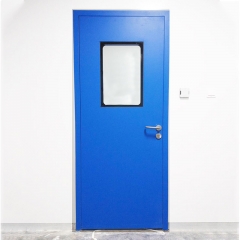
Overview: Clean room steel door is made up of steel frame and PCGI(powder coated galvanized iron)door panel. It has high strength, strong impact resistance and good fire resistance. Clean room steel door usually used in electronics factories, chemical plants, pharmaceutical factories and food factories and so on.
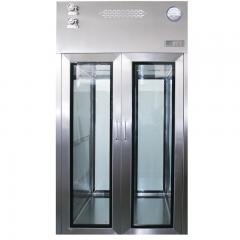
Overview: Pass box is a kind of auxiliary equipment for clean room. It is mainly used for the transfer of small items between clean area to another clean area, between clean area and non-clean area, to reduce the number of times the clean room is opened and pollute the clean room. Reduce to a minimum. The transfer window is made of stainless steel and is smooth and smooth. The double doors are interlocked to each other to effectively prevent cross-contamination. They are equipped with electronic or mechanical interlocking devices and equipped with ultraviolet germicidal lamps.
System Overview A PIR Cleanroom Panel bonds two coated-steel facings to a rigid polyisocyanurate (PIR) foam core — a high-insulation, fire-improved cleanroom wall and ceiling panel made to a ≤ 2 mm/2 m flatness tolerance. Key advantages: Insulation + Better Fire: Near-PU thermal performance with an upgraded Class B1 fire rating. Chars, Doesn't Melt: Forms a stable char with low smoke under fire, improving fire integrity. Lightweight & Sealed: Closed-cell core blocks moisture, with a strong facing bond and clean surface.

Constructed with anti-static PVC strip curtains and a lightweight industrial frame, it provides excellent accessibility, static dissipation, and reliable particle protection for ESD-sensitive processes. This unit is ideal for applications requiring ISO Class 7–8 (Class 10,000–100,000) cleanliness with frequent personnel or material movement.

Overview: Interlock system uses interlocked doors to prevent simultaneous opening, maintaining pressure and contamination control. Available in pass-through and airlock types, it manages airflow, prevents cross-contamination, and supports safe transfer protocols. Essential for pharmaceutical and biotech cleanrooms, it ensures GMP compliance and operational safety.
Overview: Data Center Ceiling is a specialized overhead system designed for IT facilities, integrating cable management, airflow containment, and fire-rated panels. It supports hot/cold aisle containment, reduces cooling costs, and ensures accessibility for maintenance. Key features include seismic resistance, modular design, and compatibility with raised floors, enabling efficient cooling management and infrastructure scalability in server rooms and data halls.
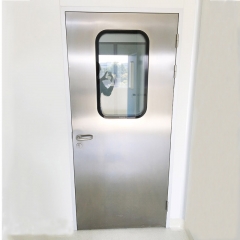
Overview: Clean Room Stainless Steel Door is constructed with corrosion-resistant stainless steel and a reinforced frame, available in swing or sliding designs. It provides an airtight, easy-to-clean barrier against particles and contaminants, supporting cleanroom integrity. Commonly fire-rated, it is used in pharmaceutical, biotech, and food processing facilities to maintain hygiene standards and ensure long-term durability.

System Overview A fiberglass panel (also known as glass fiber insulation board or FR-4) is an asbestos-free composite synthesized from glass fiber and high heat-resistance resin, offering high mechanical and dielectric strength alongside exceptional heat and moisture resistance and superior processability. Widely specified for plastic molds, machine manufacturing, and PCB fixtures, it also performs as a sound-absorbing wall and ceiling material, replacing ultra-fine glass wool felt in cold-storage rooms, broadcast studios, and ventilation trenches. Key architectural advantages include: Wide Temperature & Moisture Resistance: Stable from −30°C to +150°C with no deterioration or mildew, far outperforming traditional cork or wood board. Precision Surface & Processability: High flatness with no pits and standard thickness tolerances make it excellent for drilling, injection molds, and precision PCB fixtures. Effective Sound Absorption: A porous structure reflects and absorbs sound waves when built with rigid, tight walls, ideal for insulation and building acoustics applications.
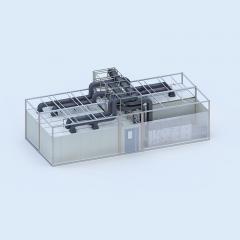
Video Showcase Overview This modular clean room video highlights Wonclean’s cleanroom design, manufacturing, installation, and project delivery capabilities for controlled environment applications. Through real project footage, engineers and procurement teams can review our cleanroom panels, modular assembly process, FFU ceiling system, and finished ISO-compliant cleanroom environment. Note: For technical specifications, layouts, and customized solutions, please visit our Modular Cleanroom product page. { "@context": "http://schema.org", "@type": "Article", "headline": "Modular Clean Room-video Design, Modular Clean Room-video Manufacturers", "author": { "@type": "Person", "url": "https://www.wonclean.com/", "name": "Wonclean" }, "image": "https://www.wonclean.com/uploadfile/202312/25/c64a2135f40633ec107f44aacea918ed_thumb.jpg", "articleBody": "Modular clean room video showing Wonclean’s cleanroom design, manufacturing, installation, and project delivery capabilities for controlled environment applications. This modular clean room video highlights cleanroom panels, modular assembly process, FFU ceiling system, and finished ISO-compliant cleanroom environment." }

 Room JT30151, Building 4, Area B, No. 925 Yecheng Road, Industrial Zone, Shanghai,China
 Info@wonclean.com
Allen@wonclean.com
Joy@wonclean.com
Info@wonclean.com
Allen@wonclean.com
Joy@wonclean.com
 +86 13671979988(Allen)+86 15950938878(Joy)


 online service

